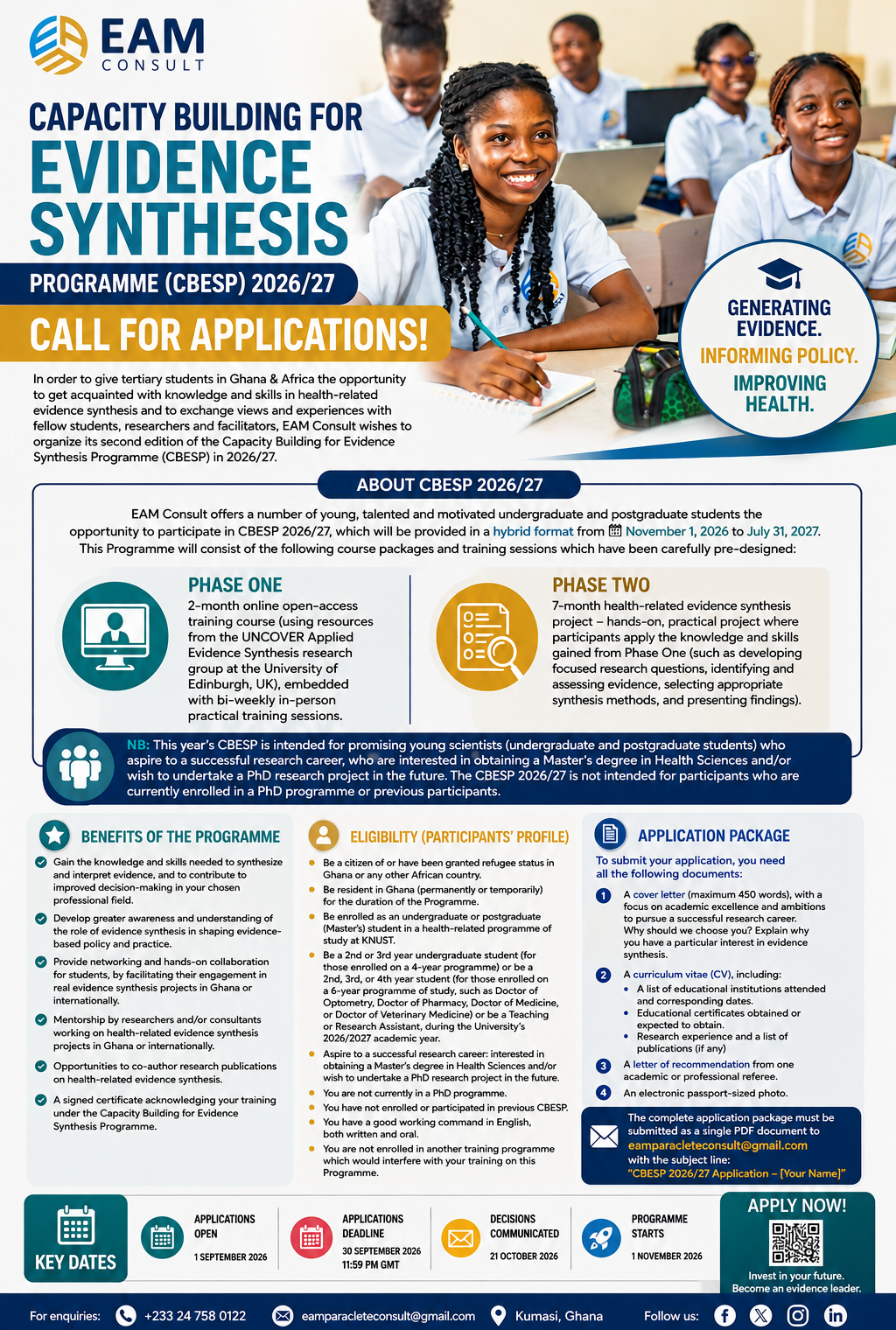
Capacity Building for Evidence Synthesis Programme (CBESP) 2026/27
Call for Applications
EAM Capacity Building & Training
In order to give tertiary students in Ghana & Africa the opportunity to get acquainted with knowledge and skills in health-related evidence synthesis and to exchange views and experiences with fellow students, researchers and facilitators, EAM Consult wishes to organize its second edition of the Capacity Building for Evidence Synthesis Programme (CBESP) in 2026/27.
CBESP 2026/27
EAM Consult offers a number of young, talented and motivated undergraduate and postgraduate students the opportunity to participate in CBESP 2026/27, which will be provided in a hybrid format from November 1, 2026, to July 31, 2027. This Programme will consist of the following course packages and training sessions which have been carefully pre-designed:
- Phase One: A 2-month online open-access training course (using resources from the UNCOVER Applied Evidence Synthesis research group at the University of Edinburgh, UK), embedded with bi-weekly in-person practical training sessions.
- Phase Two: A 7-month health-related evidence synthesis project – hands-on, practical project where participants apply the knowledge and skills gained from Phase One (such as developing focused research questions, identifying and assessing evidence, selecting appropriate synthesis methods, and presenting findings).
NB: This year’s CBESP is intended for promising young scientists (undergraduate and postgraduate students) who aspire to a successful research career, who are interested in obtaining a Master’s degree in Health Sciences and/or wish to undertake a PhD research project in the future. The CBESP 2026/27 is not intended for participants who are currently enrolled in a PhD programme or previous participants.
Benefits of the Programme
This programme is intended to offer the following benefits to students:
- Gain the knowledge and skills needed to synthesize and interpret evidence, and to contribute to improved decision-making in your chosen professional field.
- To develop greater awareness and understanding of the role of evidence synthesis in shaping evidence-based policy and practice.
- Provide networking and hands-on collaboration for students, by facilitating their engagement in real evidence synthesis projects in Ghana or internationally.
- Mentorship by researchers and/or consultants working on health-related evidence synthesis projects in Ghana or internationally.
- Opportunities to co-author research publications on health-related evidence synthesis.
- A signed certificate acknowledging your training under the Capacity Building for Evidence Synthesis Programme.
Eligibility (Participants’ profile)
Applicants who meet the following criteria will be considered for this Programme:
- Be a citizen of or have been granted refugee status in Ghana or any other African country.
- Be resident in Ghana (permanently or temporarily) for the duration of the Programme.
- Be enrolled as an undergraduate or postgraduate (Master’s) student in a health-related programme of study at the Kwame Nkrumah University of Science and Technology (KNUST), Ghana.
- Be a 2nd or 3rd year undergraduate student (for those enrolled on a 4-year programme of study) or be a 2nd, 3rd, or 4th year student (for those enrolled on a 6-year programme of study, such as Doctor of Optometry, Doctor of Pharmacy, Doctor of Medicine, or Doctor of Veterinary Medicine) or be a Teaching or Research Assistant, during the University’s 2026/2027 academic year.
- You aspire to a successful research career: you are interested in obtaining a Master’s degree in Health Sciences and/or wish to undertake a PhD research project in the future.
- You are not currently in PhD programme.
- You have not enrolled or participated in previous CBESP.
- You have a good working command in English, both written and oral.
- You are not enrolled in another training programme which would interfere with your training on this Programme.
Application package
To submit your application, you need all the following documents:
- A cover letter (maximum 450 words), with a focus on academic excellence and ambitions to pursue a successful research career. Why should we choose you? Explain why you have a particular interest in evidence synthesis.
- A curriculum vitae (CV), including:
- educational certificates obtained or expected to obtain.
- a list of educational institutions attended and corresponding dates.
- research experience and a list of publications (if any)
- A letter of recommendation from one academic or professional referee.
- An electronic passport-sized photo.
The complete application package must be emailed as one PDF file to: eamparacleteconsult@gmail.com. Please include “CBESP 2026/27 Application – [Your Name]” in the email subject line and name your single PDF file using your surname and first name (e.g., “Mensah_Rebecca”). All queries about the application should be sent to Dr. Nana Akwasi Owusu Mensah (nanaakwasiowusumensah@gmail.com).
Please note that we only accept and assess complete application packages! Application and enrollment into CBESP 2026/27 is absolutely FREE!!!
Application deadline
Wednesday September 30, 2026; 23:59 GMT
Selection procedure
You will be informed about the outcome of the first selection process by October 9, 2026. Applicants who pass the first selection process will be invited for an interview between October 12 and 16, 2026. The interview serves to further evaluate candidates beyond their initial application materials.